
Technology
From biology to scalable products.
We combine biological science, process engineering and product development to turn under-used biological resources into materials and products people use.
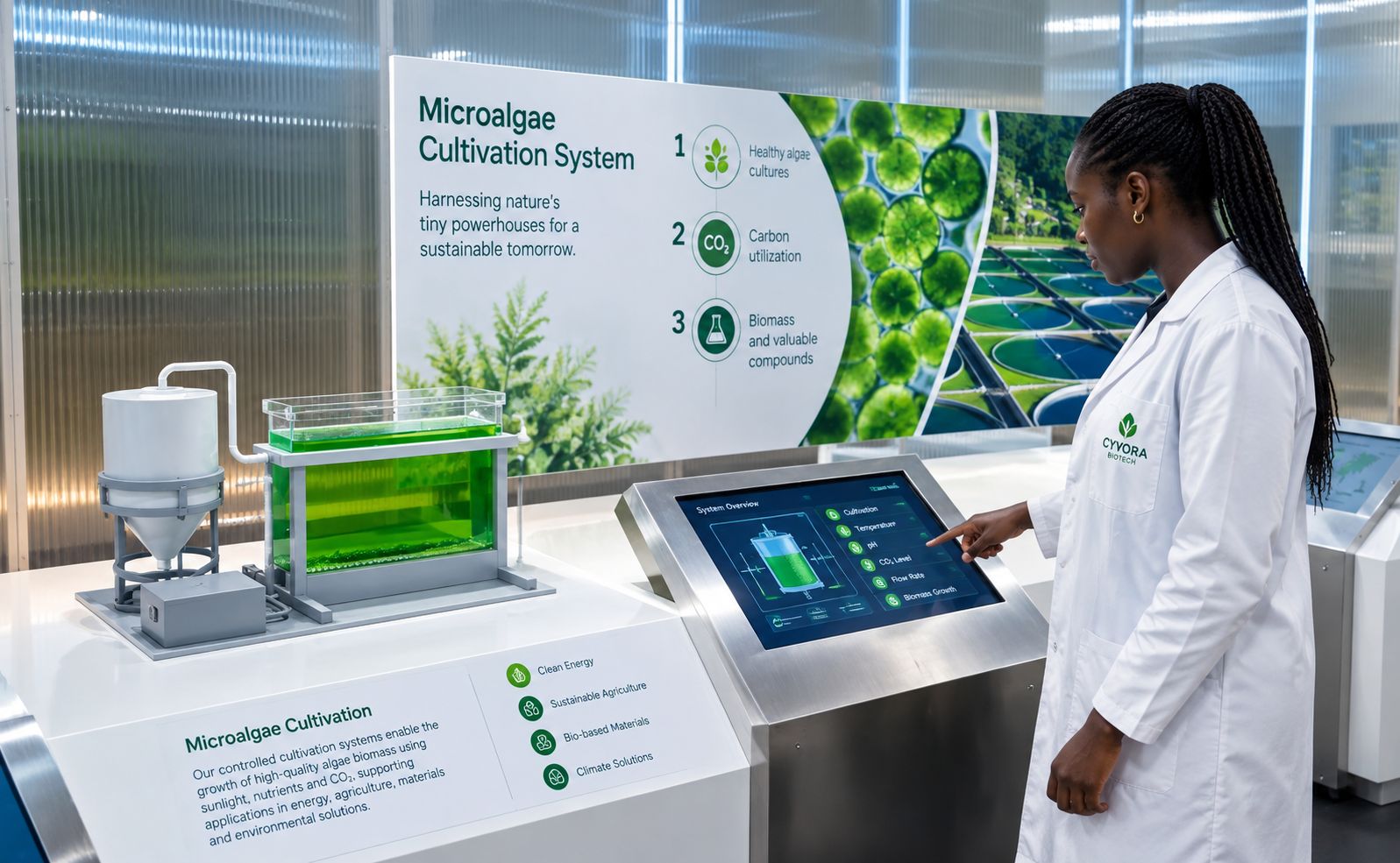
The platform
How the platform works
Inputs
- Organic waste streams
- Carbon dioxide
- Water and nutrients
- Sunlight
Technology
- Algae cultivation
- Bioconversion
- Carbon utilisation
- Downstream processing
Outputs today
- Bio-fertilizer
- Animal and aquaculture feeds
- Algae biomass
- Aquaponics systems
Outputs in development
- Carbon solutionsPILOT
- BioenergyPILOT
- BiomaterialsR&D
- Monitoring and automationR&D
Each of these is listed in the pipeline with its current stage.
Algae: our flagship platform
Why algae?
Algae are among nature's most efficient biological systems. Like plants, they use photosynthesis to turn sunlight, carbon dioxide and water into sugars and oxygen. Unlike most crops, many algae grow quickly in water rather than soil, can use nutrients that would otherwise be wasted, and don't compete for farmland.
That makes algae a platform rather than a single product: one cultivation system can produce biomass for feed, fertilizer and, with further processing, many other materials.
The algae platform, stage by stage
- Cultivation
Growing selected algae under controlled conditions for consistent, healthy biomass.
- Carbon utilisationPILOT
Supplying CO₂ as a feedstock for growth.
- BiomassCOMMERCIAL
Harvesting and concentrating the algae as a raw material.
- BiorefiningR&D
Separating biomass into several product streams, such as protein, oils and pigments.
- Product developmentCOMMERCIAL
Turning those fractions into finished products. Commercial for feed and fertilizer.
The circular loop
Nothing is wasted. Biology keeps the loop moving.
- 01
Organic waste
Food, market and agricultural residues that would otherwise be dumped or burned.
- 02
Biological processing
Microbes break waste down and stabilise it, releasing nutrients.
- 03
Algae and microbial systems
Living systems take up those nutrients, and CO₂, and grow.
- 04
Biomass and bio-based molecules
The harvest: protein, organic matter and useful compounds.
- 05
Products
Fertilizer, feeds, algae biomass today, with more in development.
- 06
Resource recovery
What's left over and what returns from the field re-enters the loop as feedstock.
Our model is built around keeping carbon, nutrients and biological value in productive use for as long as possible, instead of treating them as end-of-life waste.
Technology areas
Four technology areas
Algae cultivation
COMMERCIALControlled cultivation systems for algae and other photosynthetic microorganisms, covering reactor or pond design, nutrient management, harvesting and biomass optimisation.
Used today for
- Cyvora Algae
- Cyvora Feeds
Bioconversion
COMMERCIALMicrobial and biological processes (such as fermentation and composting) that turn organic waste into stable, useful intermediates and products.
Used today for
- Cyvora Biofert
Carbon utilisation
PILOTBiological pathways that use carbon dioxide as an input to productive systems, rather than treating it only as an emission.
Being piloted as
- Cyvora Carbon
Downstream processing
COMMERCIALR&DDrying, formulation and packing are in commercial use. Extraction, purification and concentration are in research.
Where it sits
- Commercial: drying, formulation, packing
- R&D: extraction, purification, concentration
What we don't claim
Clear about what's proven.
Biotechnology moves from the laboratory to the market in stages. Every technology on this site carries a label (Commercial, Pilot, Prototype or R&D) so you always know which stage it has reached. We publish performance figures only when we can show how they were measured.
See our research & pipelineBuild it with us.
We're looking for research institutions, industrial partners and funders to pilot and scale our next technologies.